 KnowThis
Key Takeaways
Key Takeaways
- 1A server isn't a special category of hardware — it's a role: a computer configured to stay running and answer requests from other computers, called clients.
- 2The same physical machine can be a server for one purpose and a client for another; "server" describes what a computer is doing in a given interaction, not a fixed identity.
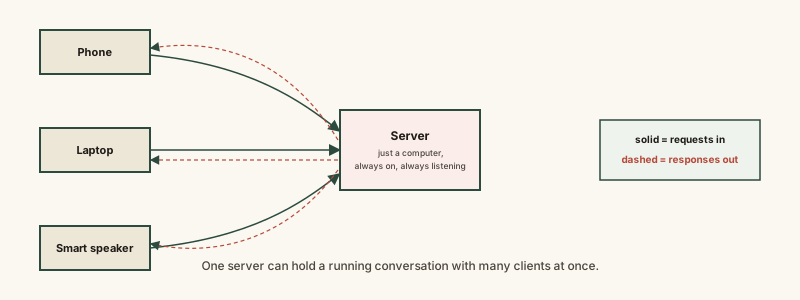
- 3A single server can hold ongoing, simultaneous request/response exchanges with many different clients, which is exactly what lets one server support thousands or millions of users.
The concept
Once "server" is understood as a role a machine is configured to play rather than a special breed of computer, a lot of otherwise-confusing phrases — "server-side," "the server is down," "my computer is now a server" — stop sounding contradictory.
A person sets up an old laptop at home to run software that lets them access their own files remotely from anywhere. What is that laptop now functioning as?
Worked examples
Example 1: Loading a website (baseline case)
A browser loads a website by sending a request to a web server. Which side initiated that exchange?
Example 2: A server that's also a client (edge case / variation)
A web server needs data from a separate database server to answer a visitor's request. What role is the web server playing when it requests that data from the database server?
Example 3: One server handling thousands of visitors at once (real-world / applied case)
A popular website stays responsive while thousands of people load pages from it at the same moment. This works because server software is built to manage many simultaneous request/response exchanges, handling each incoming request, generating its own response, and moving to the next — often within milliseconds — rather than serving one visitor fully before even acknowledging the next. For very high traffic, this single-server picture usually expands into multiple servers working together (the redundancy and load-balancing setup covered in what uptime means for online services), but the core request/response mechanism scales up from the same basic client-server exchange happening at massive volume.
A single server manages to respond to thousands of visitors loading pages at nearly the same moment. How is this possible?
How it works (visual)
Common mistakes
Common Mistakes
Believing a server must be exotic, specialized hardware fundamentally unlike a regular computer.
→ Server describes a role — a computer configured to run continuously and answer requests — that ordinary hardware can play, though production servers are often built for durability and simultaneous-connection handling.
Assuming a machine is permanently 'a server' or permanently 'a client.'
→ The same machine can be a server in one exchange and a client in another (or even both at once), depending on which side of a given request it's on.
Thinking a server can only handle one request or one visitor at a time.
→ Server software is specifically designed to manage many simultaneous request/response exchanges — that's exactly what lets a single server support large numbers of concurrent users.
Common misconception
“Servers are a completely different category of computer, unrelated to the laptop or phone I use.”
A server is a role, not a category of hardware. It's a computer (or software on one) configured to stay running and respond to requests from other computers. Production servers often use hardware built for durability and handling many connections at once, but the underlying concept — a machine listening for and answering requests — is exactly the same mechanism your own device uses whenever it briefly acts as a server, such as sharing files with another device on the same network.
What to do next
What to do next
- Next time you hear 'the server is down,' picture a specific machine that stopped responding to requests, not an abstract outage.
- Notice when your own device briefly plays server (like sharing a file or screen with another device nearby) versus client (loading a website).
- If you're evaluating hosting options, remember 'server' capacity is really about how many simultaneous request/response exchanges a machine can sustain, not just raw processing power.
- Read What an API Actually Does next to see the structured request format a server is typically built to understand and answer.