 KnowThis
Key Takeaways
Key Takeaways
- 1A living will states specific treatment wishes in advance; a healthcare power of attorney names a person to make broader medical judgment calls — they solve different problems.
- 2Both documents only take effect once a doctor determines the person can't make or communicate their own medical decisions — they have no effect while someone is capable of deciding for themselves.
- 3Most complete advance care plans combine both documents, since a living will can't anticipate every possible medical scenario the way a trusted decision-maker can adapt in the moment.
The concept
Because these documents only activate during incapacity, choosing who to name (and what to specify) matters far more than most people initially assume, since it's the plan the family and medical team fall back on precisely when the person can't clarify anything themselves.
When does a living will or healthcare power of attorney actually take legal effect?
Worked examples
Example 1: A living will addressing a specific, anticipated scenario (baseline case)
Example 2: A situation the living will didn't anticipate (edge case / variation)
Example 3: No advance directive at all (real-world / applied case)
Why do many estate planning resources recommend having both a living will and a healthcare power of attorney, rather than just one?
How it works (visual)
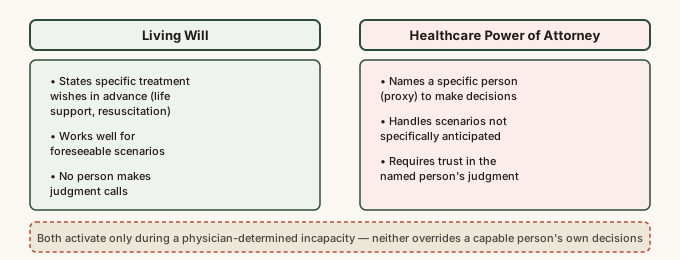
Neither document is a strict substitute for the other — they're designed to cover each other's blind spots when used together.
Common mistakes
Common Mistakes
Assuming a living will alone covers every possible future medical scenario.
→ Pair a living will with a healthcare power of attorney so a trusted person can make judgment calls on situations the living will's specific language doesn't address.
Naming a healthcare proxy without ever discussing personal values and wishes with them.
→ Have an actual conversation with the named proxy about general preferences and priorities, not just handing them a signed form — that context is what makes their judgment calls in the moment more reliable.
Assuming these documents also control what happens to property after death.
→ Recognize these are medical decision-making documents active during a person's life, entirely separate from a will or estate plan, which addresses property after death.
Common misconception
“Signing a living will means doctors will simply let you die rather than treat you.”
A living will only specifies wishes about particular treatments in particular circumstances — commonly around end-of-life care where recovery isn't reasonably expected — and doesn't broadly instruct doctors to withhold ordinary treatment. It also only takes effect during a physician-determined incapacity; while a person can communicate, their own real-time decisions govern their care regardless of what an earlier document says. The purpose is to ensure a person's actual wishes are followed in a hard scenario, not to pre-authorize withholding care generally.
What to do next
What to do next
- Confirm the specific advance directive forms and terminology used in your jurisdiction (some combine both documents into one).
- Name both a healthcare proxy and at least one backup, and have an actual conversation with them about your values and priorities.
- Give copies of the signed documents to your proxy, close family, and your primary physician — a document no one can find is not useful in an emergency.
- Review and update these documents periodically, especially after a major health change or change in who you'd trust to make decisions.