Guardianship is a court-supervised legal arrangement giving a named adult authority to make decisions for someone who can't fully make or communicate their own decisions — typically a minor child (after a parent's incapacity or death) or an incapacitated adult — and it always requires actual court appointment, not just a private designation form, though naming a preferred guardian in advance carries real legal weight with the court. This is general legal literacy, not personalized legal advice.
Reading time
— 4 min
Updated
— Aug 26, 2026
Fact-reviewed
— Aug 26, 2026
Key Takeaways
Key Takeaways
1Guardianship always requires actual court appointment — a private nomination form expresses a preference but doesn't itself grant legal authority over a child or incapacitated adult.
2Guardianship generally applies to two distinct situations: minor children (after a parent's death or incapacity) and adults a court has determined can't manage their own affairs.
3Naming a preferred guardian for a minor child in a will or a standalone nomination carries real legal weight with the court, even though it isn't itself the final, binding appointment.
The concept
A guardian is an adult a court gives legal authority to make decisions for someone who can't fully make decisions themselves — most commonly a minor child whose parents have died or become unable to care for them, or an adult who a court has found can't manage their own affairs. A parent can name who they'd prefer as guardian in a will or a separate document, but that alone doesn't make it official — a court still has to formally appoint the guardian.
Because court appointment is always the final step, the practical value of advance documentation is in making that court's decision easier and more aligned with the family's actual wishes — not in skipping the court process altogether.
Quick check
Does naming a preferred guardian for a minor child in a will automatically make that person the legal guardian?
Worked examples
Example 1: A parent naming a guardian for minor children in a will (baseline case)
Two parents each name the same sibling as preferred guardian for their minor children in their wills. If both parents later die while the children are still minors, that will provision doesn't instantly transfer custody — a court holds a hearing, reviews the nomination, and, absent a compelling reason otherwise, typically formalizes the named sibling as legal guardian.
Example 2: No guardian nomination on file (edge case / variation)
The same scenario, but the parents never documented a preference anywhere. A court still appoints a guardian, but without a documented preference to weigh, the process typically involves a broader search among relatives and can take longer, with a greater chance of disagreement among family members about who should serve — illustrating why documenting a preference matters even though it isn't itself the final legal step.
Example 3: Guardianship for an incapacitated adult (real-world / applied case)
An adult develops a severe cognitive condition and can no longer manage medical decisions or finances, with no healthcare power of attorney or financial power of attorney previously in place. A family member petitions a court for guardianship (and, depending on the jurisdiction, conservatorship for financial matters), the court requires a medical evaluation confirming incapacity, and only after a formal hearing does the family member gain actual legal decision-making authority — a slower and more involved process than if the adult had set up powers of attorney in advance while still capable.
Quick check
Why might having a documented guardian preference (for a minor) or an existing power of attorney (for an adult) matter, even though a court still has final authority in guardianship cases?
How it works (visual)
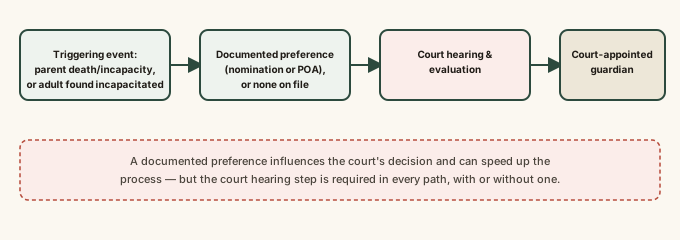
From documented preference to court-appointed guardian
The court hearing step is present in every path — what changes is how much documented guidance the court has to work with when it gets there.
Common mistakes
Common Mistakes
✕
Assuming a signed guardian nomination alone is legally sufficient, with no court process needed.
→ Understand that a nomination is influential but not binding by itself — actual legal authority always requires a court's formal appointment.
✕
Never naming a preferred guardian for minor children, assuming 'it won't matter' or 'it's obvious who it would be.'
→ Document a preference anyway, even an obvious one — it gives the court clear guidance and can meaningfully speed up and simplify the process if it's ever needed.
✕
Waiting until an adult family member is already incapacitated to consider powers of attorney, rather than setting them up in advance.
→ Set up healthcare and financial powers of attorney while a person is still capable — doing so can reduce or eliminate the need for a court guardianship proceeding later.
Common misconception
“Naming someone as guardian in a will means they automatically become the child's guardian the instant it's needed, with no other steps.”
A guardian nomination in a will is a strong, documented statement of preference that courts generally respect and weigh heavily — but it is not itself a legal transfer of guardianship authority. A court still holds a hearing and formally appoints the guardian, which typically (though not always) confirms the parent's stated preference. The nomination's real value is making that court process faster, clearer, and less likely to be contested — not skipping the process.
What to do next
What to do next
Document a preferred guardian for minor children in a will or a standalone nomination, even if the choice seems obvious.
Discuss the responsibility with the person being named before listing them, so there's no surprise if the arrangement is ever activated.
Set up healthcare and financial powers of attorney for adults while they're still capable, to reduce reliance on court guardianship later.
Consult a licensed attorney for the specific guardianship or conservatorship procedures and terminology in the relevant jurisdiction.
FAQ
FAQ
Related terms
Related terms
Guardian
An adult granted legal authority by a court to make personal, medical, or financial decisions for someone who can't fully make those decisions themselves — a minor child or an incapacitated adult.
Ward
The person under a guardian's legal authority — either a minor child or an adult a court has determined lacks the capacity to manage their own affairs.
Conservatorship
In many jurisdictions, a related or overlapping arrangement specifically focused on managing an incapacitated person's finances and property, sometimes distinct from (and sometimes combined with) guardianship over personal/medical decisions.
Standby guardian nomination
A document where a parent names a preferred guardian for their minor child in advance — it carries real weight with a court but doesn't itself grant legal authority; a court still has to formally appoint the guardian.
This entry was researched from public sources and drafted with AI-assisted tools, then edited — errors are still possible. Spot one, or want a topic covered? Read our disclaimer.
 KnowThis