 KnowThis
Key Takeaways
Key Takeaways
- 1Probate is the court process that actually authorizes the transfer of a deceased person's property — it happens whether or not there's a will, just following different rules in each case.
- 2With a valid will, probate follows the testator's written instructions; without one, a jurisdiction's default intestate succession formula decides who inherits instead.
- 3Not all property passes through probate — assets with a named beneficiary (like life insurance or certain retirement accounts) or held jointly with rights of survivorship typically transfer outside the probate process entirely.
The concept
The presence or absence of a valid will changes which rulebook probate follows, but it doesn't change whether probate happens for probate-eligible assets in the first place.
If someone dies owning a house solely in their own name and a joint bank account with rights of survivorship with their spouse, which asset typically must go through probate?
Worked examples
Example 1: Probate with a valid will (baseline case)
Example 2: Intestate succession with no will (edge case / variation)
Example 3: Assets that bypass probate entirely (real-world / applied case)
Why do life insurance proceeds with a named beneficiary typically skip probate?
How it works (visual)
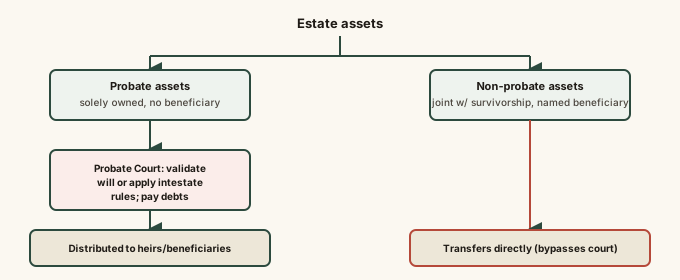
How an asset is titled — solely owned versus jointly held or beneficiary-designated — is what determines which path it takes, not whether a will exists.
Common mistakes
Common Mistakes
Assuming having a will means an estate skips probate entirely.
→ Recognize that a will guides probate rather than replacing it — avoiding probate for specific assets generally requires different tools, like proper account titling or certain trusts.
Assuming intestate succession rules automatically match what the deceased person would have wanted.
→ Understand that intestate succession is a fixed, generic legal formula — it doesn't account for personal relationships, informal promises, or unique family circumstances the way a will can.
Overlooking that non-probate assets (joint accounts, named-beneficiary accounts) transfer by their own rules, separate from whatever the will says.
→ Check the actual titling and beneficiary designations on each account, since a will's instructions don't override a conflicting beneficiary designation on file with the account custodian.
Common misconception
“Probate is always a long, expensive process that should be avoided at all costs.”
Probate's length and cost vary enormously depending on the estate's size, complexity, and jurisdiction — many places offer a simplified, faster process for smaller estates, and an uncontested estate with clear documentation often moves through probate without major expense. Probate also serves real functions, like giving creditors a formal window to make claims and providing legal certainty about ownership transfer, that aren't automatically bad outcomes to avoid — the right question for a specific estate is best answered with a licensed estate attorney, not a blanket assumption either way.
What to do next
What to do next
- Check the titling and beneficiary designations on major accounts (retirement, life insurance, bank accounts) — they generally transfer outside probate regardless of what a will says.
- Confirm whether the relevant jurisdiction offers a simplified small-estate probate process before assuming a lengthy full process applies.
- If acting as an executor or administrator, keep organized records of every estate transaction, since probate courts typically require an accounting.
- Consult a licensed estate or probate attorney for anything beyond the most straightforward, uncontested estate.