 KnowThis
Key Takeaways
Key Takeaways
- 1Adoption is legally final only once a court issues an adoption decree — the process before that (matching, placement, a home study) builds toward that decree but doesn't itself transfer parental rights.
- 2Terminating the birth parents' legal rights is generally a required, separate legal step that has to happen (voluntarily or through a court process) before an adoption can be finalized.
- 3The specific process differs meaningfully by adoption type — domestic infant, foster care, stepparent, and international adoptions each follow different paperwork paths and timelines.
The concept
Because the decree is the step that actually and permanently transfers parental rights, every earlier stage — matching, placement, the home study, even a signed voluntary relinquishment — functions as preparation for that final court action, not a substitute for it.
Is an adoption legally final once a child has been placed with the prospective adoptive family?
Worked examples
Example 1: A domestic infant adoption (baseline case)
Example 2: A stepparent adoption (edge case / variation)
Example 3: An international adoption's extra paperwork layer (real-world / applied case)
Why does a stepparent adoption typically follow a different (often faster) process than a domestic infant adoption from an unrelated birth parent?
How it works (visual)
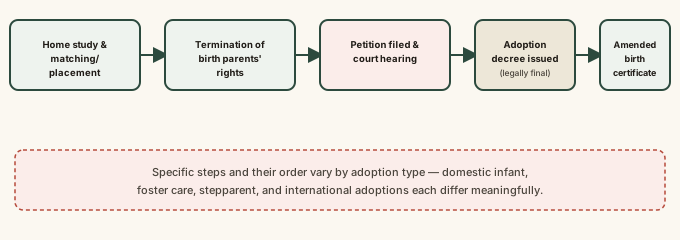
The decree is the pivot point in this sequence — everything before it is preparation, and everything after it (like the amended birth certificate) simply documents a legal relationship that already exists.
Common mistakes
Common Mistakes
Assuming a child living with prospective adoptive parents means the adoption is already legally complete.
→ Recognize that placement and even a signed relinquishment are steps toward finalization, not the final legal act — only the court's adoption decree permanently transfers parental rights.
Overlooking those required termination-of-parental-rights steps for a stepparent or relative adoption.
→ Confirm what's specifically required to terminate the non-custodial birth parent's rights in that jurisdiction — this step is often still required even when other parts of the process are streamlined.
Assuming a foreign adoption automatically grants full legal status and citizenship at home without any additional paperwork.
→ Check whether the relevant country requires an additional domestic recognition, re-adoption, or immigration process on top of the foreign adoption itself.
Common misconception
“All adoptions follow the exact same process and paperwork, regardless of the situation.”
Domestic infant, foster care, stepparent, and international adoptions each follow meaningfully different paths, with different required steps, timelines, and agencies involved — a foster care adoption starts from an existing state custody relationship, a stepparent adoption may skip a formal home study, and international adoption adds a second country's legal requirements plus immigration paperwork. Treating "adoption" as a single uniform process can lead to missing steps that are specifically required for the actual situation involved.
What to do next
What to do next
- Identify which type of adoption applies (domestic infant, foster care, stepparent, international) since the required process differs meaningfully by type.
- Confirm what's required to terminate the non-custodial birth parent's legal rights in the relevant jurisdiction.
- Work with a licensed adoption attorney or an accredited adoption agency, especially for international or contested cases.
- After finalization, request the amended birth certificate and keep the adoption decree in a secure, accessible place.