 KnowThis
Key Takeaways
Key Takeaways
- 1A marriage license is permission to marry, obtained before the ceremony; a marriage certificate is proof the marriage happened, issued after — they're sequential, not interchangeable.
- 2The marriage only becomes a legally recognized fact once the signed license is filed with the appropriate government office after the ceremony — the ceremony alone isn't the final step.
- 3Marriage licenses typically expire after a set window if unused, and requirements (waiting periods, required documents, witness counts) vary substantially by jurisdiction.
The concept
Because the certificate depends on the license being properly filed after the ceremony, the paperwork step immediately following a wedding is not just administrative housekeeping — it's what actually finalizes the legal marriage in the official record.
Which comes first: the marriage license or the marriage certificate?
Worked examples
Example 1: The standard sequence (baseline case)
Example 2: A license that expires unused (edge case / variation)
Example 3: Needing a certified marriage certificate for a legal purpose (real-world / applied case)
A couple's officiant fails to file their signed marriage license with the government office after the wedding. What's the practical consequence?
How it works (visual)
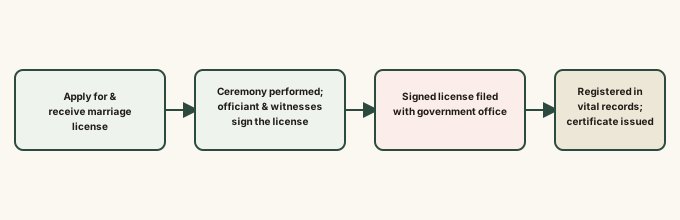
Each step is a prerequisite for the next — a ceremony performed without a valid license, or a signed license never filed, breaks the chain that produces an official, certifiable marriage record.
Common mistakes
Common Mistakes
Letting a marriage license expire before the wedding ceremony takes place.
→ Check the license's validity window when applying and time the application so it doesn't expire before the planned ceremony date.
Assuming the wedding ceremony alone is the final legal step.
→ Confirm the signed license actually gets filed with the appropriate government office afterward — that filing is what creates the official marriage record.
Confusing the marriage license (kept as a personal souvenir) with the marriage certificate needed for legal purposes.
→ Request certified copies of the actual marriage certificate from the vital records office for uses like name changes, insurance, or immigration paperwork — not the original license.
Common misconception
“A marriage license and a marriage certificate are just two names for the same document.”
They're sequential, functionally different documents. The license is issued before the ceremony and grants time-limited permission to marry; the certificate is issued after the ceremony and signed license are filed, and serves as the actual official proof the marriage occurred. Many institutions specifically require the certificate, not the license, for legal purposes like name changes or benefits enrollment — treating them as interchangeable can lead to submitting the wrong document.
What to do next
What to do next
- Check the specific marriage license requirements, waiting period, and validity window for your jurisdiction before applying.
- Confirm with your officiant who is responsible for filing the signed license after the ceremony, and by when.
- Order several certified copies of the marriage certificate once available — many institutions require an original certified copy, not a photocopy.
- Keep the certificate somewhere secure and accessible, since it's commonly needed years later for benefits, name changes, or other legal purposes.