 KnowThis
Key Takeaways
Key Takeaways
- 1Almost all international internet traffic — not just a portion of it — travels through physical fiber-optic cables laid on the ocean floor, not through satellites.
- 2These cables carry data as pulses of light through thin glass fibers, and because light loses strength over very long distances, repeaters are spaced along the cable to amplify the signal periodically.
- 3The internet is, at its physical foundation, a network of specific, mappable cables connecting specific landing points on specific coastlines — not an abstract, placeless 'cloud.'
The concept
Once you picture the internet's international backbone as a specific set of physical, mappable cables rather than an abstract cloud, a lot of otherwise-surprising facts — a single cable cut causing regional outages, cable maps being a real, published resource — stop being surprising at all.
When you make an international video call, how does most of that data actually travel between continents?
Worked examples
Example 1: Sending an email across an ocean (baseline case)
Example 2: A single cable cut causing a regional outage (edge case / variation)
A submarine cable serving a coastal region is accidentally damaged by a ship's anchor. Why can this cause a noticeable regional internet slowdown even though other cables continue working?
Example 3: Choosing a route for a new international cable (real-world / applied case)
Companies and consortiums planning a new submarine cable route carefully survey the ocean floor to avoid known hazards — steep underwater terrain, existing cables, heavy fishing or anchoring zones, and geologically unstable areas — before laying a new route. This is a deliberate risk-reduction exercise: since a cable represents a large capital investment and repairs are slow and costly, minimizing the chance of accidental damage during the cable's operational life (which can span decades) is built into the planning from the start, alongside choosing landing station locations with stable political and regulatory environments.
How it works (visual)
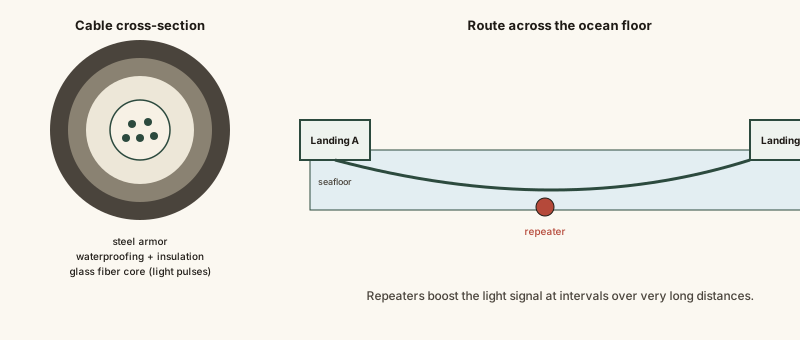
The cable's physical construction — glass fibers wrapped in progressively tougher protective layers — reflects the harsh environment it has to survive on the seafloor for decades, while the repeater shown partway along the route is what keeps the light signal strong enough to read correctly over such a long, continuous distance.
Common mistakes
Common Mistakes
Assuming international internet traffic mostly travels through satellites.
→ The overwhelming majority of international data travels through physical submarine fiber-optic cables — satellites carry only a small fraction, useful mainly for remote or hard-to-cable areas.
Picturing 'the cloud' as a placeless, purely wireless abstraction with no physical infrastructure.
→ Remember that even cloud services ultimately depend on a physical network of data centers connected by real, mappable fiber-optic cables, including specific undersea routes between continents.
Assuming a damaged submarine cable is repaired within hours, like a local power line.
→ Repairing an undersea cable requires a specialized cable ship to locate, raise, splice, and re-lay the damaged section — a process that commonly takes days to weeks, not hours.
Believing every country has many redundant cables, so no single cable really matters.
→ Some regions depend on a relatively small number of cables for most of their international capacity, which is exactly why a single cable's damage can cause a noticeable regional slowdown.
Common misconception
“The internet is a wireless, placeless system with no meaningful physical infrastructure connecting countries.”
International internet traffic overwhelmingly depends on a specific, mappable network of physical fiber-optic cables laid across ocean floors, connecting named landing stations in named countries. Organizations like TeleGeography maintain detailed public maps of these routes precisely because the physical layout matters enormously — for capacity planning, for understanding outage risk, and for basic geopolitical and economic reasons tied to who controls which routes.
Try it yourself
Light travels slower through glass fiber than through a vacuum — roughly 200,000 kilometers per second, about two-thirds the speed of light in a vacuum, due to the fiber's refractive index. This estimates the pure propagation delay for a given cable distance, ignoring equipment and routing delays.
Real-world delay is somewhat higher due to repeaters, routing equipment, and the cable's actual path not being perfectly straight.
What to do next
What to do next
- Look up a public submarine cable map to see the actual physical routes your international internet traffic likely follows.
- Next time an international connection feels slower than usual, consider that a specific cable route's congestion or damage — not just your local network — can be a real contributing factor.
- Remember that 'the cloud' still depends on real cables and real data centers in real physical locations, useful context for understanding outages and data-sovereignty discussions.
- Read Latency Explained next to see how physical distance, including undersea cable routes, sets a hard floor on how fast international connections can ever feel.