 KnowThis
Key Takeaways
Key Takeaways
- 1Search results are not a neutral master list — a search engine builds its own index of the web in advance, then scores and ranks whatever's in that index against your specific query.
- 2Ranking runs on hundreds of combined signals (text relevance, page speed, mobile usability, how many reputable pages link to it, and more) rather than one single 'best page' criterion.
- 3A page has to be discovered and allowed into the index before it can rank at all — being well-written but uncrawled or blocked from indexing means it never enters the competition in the first place.
The concept
That two-stage structure — get into the index first, then compete on ranking signals — explains almost every confusing search behavior people notice, from why a brand-new page takes time to show up at all, to why two pages with near-identical content can rank very differently.
A search engine returns results almost instantly after you type a query. What does this tell you about how the search actually happens?
Worked examples
Example 1: Why a brand-new page doesn't show up in results right away (baseline case)
A newly published web page doesn't appear in search results yet, even though the writing is high quality. What is the most likely explanation?
Example 2: Two similar pages, very different rankings (edge case / variation)
Two nearly identical articles are both fully indexed, but one ranks noticeably higher. What does this most likely reflect?
Example 3: A page accidentally blocked from search entirely (real-world / applied case)
A company relaunches its website and, months later, notices traffic from search has dropped to nearly zero. An audit finds that the new site was accidentally deployed with a sitewide noindex instruction left over from a staging/testing version, telling every search engine to leave every page out of the index. Because indexing is a prerequisite for ranking, no amount of content quality, backlinks, or page speed matters once that instruction is in place — the pages are simply not eligible to appear in results at all until the instruction is removed and the site is recrawled.
A company's search traffic drops to nearly zero after a site relaunch, and the cause turns out to be a leftover noindex instruction applied to the whole site. Why does this completely eliminate search visibility rather than just lowering rankings?
How it works (visual)
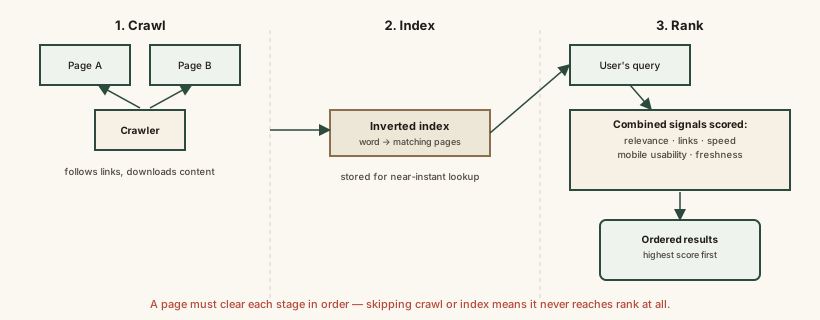
Notice the one-way order: a page can't skip ahead to ranking without first passing through crawling and indexing, and a problem at any earlier stage (an unlinked page, a blocked crawler, a noindex instruction) removes it from every later stage automatically.
Common mistakes
Common Mistakes
Assuming the top result is the objectively 'best' or most accurate page on the internet for that topic.
→ Treat the top result as the page that scored highest on that engine's combined ranking signals for that specific query — a useful signal, but not a guarantee of accuracy or completeness.
Believing that publishing content guarantees it will appear in search results.
→ Remember publishing only makes a page eligible to be crawled — it still has to be discovered, indexed, and not blocked by a noindex instruction before ranking even applies.
Chasing a single ranking factor (like keyword repetition) and expecting it to dominate the result.
→ Recognize ranking as a combined score across many signals — improving one factor in isolation rarely overcomes weaknesses in the others.
Common misconception
“Search engines show the single objectively best answer to every query, in a fixed, unbiased order.”
A search engine returns the pages, from its own index, that score highest against its own combined ranking signals for that specific query — a ranked estimate of relevance and usefulness, not an objective, universal judgment of truth. Two different search engines, or the same engine at two different times, can rank the same set of pages differently because their signals and weighting aren't identical, and because the underlying index itself is never a complete copy of the entire web.
What to do next
What to do next
- When a search result seems off, remember you're seeing one engine's ranked estimate from its own index, not a universal, verified answer — cross-check important claims against a second source.
- If you publish a website, check whether it's crawlable and free of accidental noindex instructions before troubleshooting why it isn't ranking well.
- Don't judge a page's accuracy purely by its rank — a top position reflects a combined score of relevance and technical signals, not a fact-check.
- Read What a Web Browser Is Actually Doing next to see what happens after you click a search result and a page actually loads.