 KnowThis
Key Takeaways
Key Takeaways
- 1Many smart devices need to send a request to a manufacturer's cloud server and get a response back for core features to work at all — this is a design choice, not a universal requirement of being smart.
- 2When a company shuts down its servers, those requests time out with no response, so cloud-dependent features stop working even though the device's physical hardware is entirely undamaged.
- 3Not every feature or every device works this way — some functions run entirely on local hardware and keep working regardless of any company's server status, which is why the actual impact varies device by device.
The concept
Once a device is understood as sending requests it expects real answers to, it becomes clear that "the company shut down" and "the device is now useless" are not automatically the same statement — the actual outcome depends on exactly which features were built to require that round trip.
A manufacturer permanently shuts down its cloud servers. What actually happens to a smart device that depended on those servers for a specific feature?
Worked examples
Example 1: A cloud-dependent smart plug's schedule stopping (baseline case)
After a manufacturer shuts down its servers, why might a smart plug's manual on/off button keep working while its scheduling feature stops?
Example 2: A device built with local control that keeps working (edge case / variation)
After its manufacturer shuts down, a smart thermostat keeps heating and cooling a home correctly but loses remote access and voice control. What does this indicate about how it was built?
Example 3: Evaluating cloud dependency before buying a smart device (real-world / applied case)
Someone comparing two similar smart locks wants to understand their long-term risk if either manufacturer eventually stops operating. Checking each product's documentation, one lock states that basic locking and unlocking via a physical keypad works entirely locally, with the cloud server used only for remote-unlock and activity-log features; the other requires an active server connection for every single lock and unlock action, including from the keypad. Applying the request-response framework, the first lock carries meaningfully less long-term risk from a future shutdown, since its core security function was specifically built not to depend on a server response at all.
When comparing two smart locks for long-term reliability risk, what specifically should a buyer check regarding server dependency?
How it works (visual)
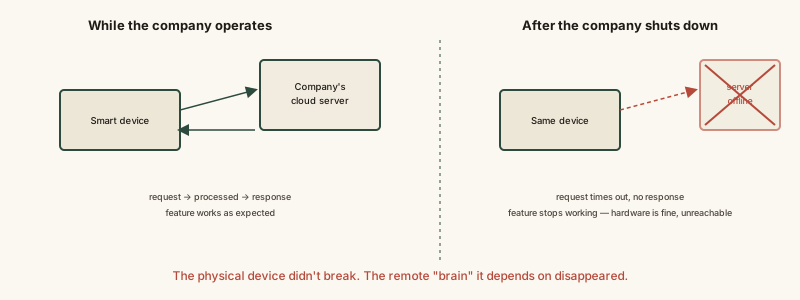
The device and its request in both halves of this diagram are identical — the only thing that changed is whether anything answers on the other end, which is exactly why a company shutdown can silently disable a feature without a single component inside the device itself failing.
Common mistakes
Common Mistakes
Assuming a smart device becomes completely useless the moment its manufacturer shuts down.
→ Check which specific features are cloud-dependent versus locally controlled — genuinely local features typically keep working regardless of the company's status.
Assuming all smart devices work the same way regarding server dependency.
→ Recognize this varies by product and even by feature within the same product — check a device's documentation for what specifically requires an internet connection to a manufacturer's server.
Buying a smart device without ever considering what happens if the company eventually stops operating.
→ Before buying, especially for core security or safety functions like locks, check whether that specific function requires an ongoing server connection or is built with local control.
Common misconception
“A smart device stops being useful the moment the company behind it shuts down.”
What actually happens depends entirely on which specific features were built to depend on a round trip to that company's now-offline server versus which run entirely on the device's own local hardware. A device's physical components are completely unaffected by a company shutting down — only features specifically requiring a response from that company's server stop functioning. Some devices lose almost everything; others keep their core function intact and only lose optional extras like remote access or voice integration.
What to do next
What to do next
- Before buying a smart device, especially for security or safety functions, check whether its core function requires an active server connection or works locally.
- Check a device's documentation or support page for language distinguishing 'local control' features from ones requiring cloud/internet connectivity.
- For an already-owned device whose manufacturer has announced end-of-life plans, identify which specific features are likely to stop working versus which are locally controlled.
- Read why smart devices need constant software updates next to see the other side of this same manufacturer-dependency relationship.