Earth takes approximately 365.2422 days to orbit the sun, not a clean 365, so a calendar using exactly 365 days every year would drift out of sync with the seasons — leap years add a corrective extra day roughly every 4 years, with a further century-based exception to keep the correction from overshooting.
Reading time
— 5 min
Updated
— Aug 21, 2026
Fact-reviewed
— Aug 21, 2026
Key Takeaways
Key Takeaways
1Earth's real orbital period is about 365.2422 days, not exactly 365 — leap years exist to correct the roughly quarter-day-per-year gap that would otherwise accumulate.
2The basic rule (add a day every 4 years) overcorrects slightly, so the Gregorian calendar adds a refinement: century years are leap years only if divisible by 400 — which is why 2000 was a leap year but 1900 and 2100 are not.
3Without leap years, the calendar would drift roughly one full day out of sync with the seasons every 4 years, eventually putting winter dates in the middle of summer over a long enough timescale.
The concept
A calendar year is 365 days, but Earth actually takes about 365.2422 days to go around the sun once — roughly a quarter day longer. If the calendar just ignored that extra quarter day every year, after four years the calendar would be off from the real seasonal cycle by about a full day, and the gap would keep growing. A leap year adds one extra day (February 29) roughly every 4 years to correct for that buildup, keeping the calendar and the actual seasons lined up.
The century exception is the part almost everyone forgets, which is exactly why it makes for a genuinely useful piece of calendar math to be able to check by hand.
Quick check
Why isn't the simple rule 'every year divisible by 4 is a leap year' good enough on its own?
Worked examples
Example 1: Checking an ordinary year (baseline case)
Is 2024 a leap year? Check: 2024 ÷ 4 = 506, an exact whole number, so 2024 passes the first test. Since 2024 isn't a century year (doesn't end in 00), the century exception doesn't apply, and 2024 is confirmed as a leap year — which matches the real calendar (2024 did have a February 29).
Example 2: The century-year exception (edge case / variation)
Is 1900 a leap year? First test: 1900 ÷ 4 = 475, a whole number, so it passes the basic 4-year rule. But 1900 is a century year (divisible by 100), which triggers the exception: century years must also be divisible by 400 to count. 1900 ÷ 400 = 4.75, not a whole number — so 1900 is not a leap year, despite passing the simple divide-by-4 test. Compare with 2000: 2000 ÷ 4 = 500 (passes), 2000 ÷ 100 = 20 (a century year, triggering the exception check), 2000 ÷ 400 = 5 (a whole number) — so 2000 is a leap year. Same basic test, opposite results, purely because of the century-divisible-by-400 refinement.
Quick check
Was the year 2100 (a future century year) a leap year under the Gregorian rule?
Example 3: What would happen without leap years, over a long timescale (real-world / applied case)
Suppose the calendar used a flat 365 days every year with no correction at all. Each year, the calendar would fall about 0.2422 days behind the true solar cycle. Over 100 years, that's roughly 100 × 0.2422 ≈ 24.2 days of accumulated drift — nearly a full month. Over 700 years, the drift would reach roughly 169 days, more than half a year, meaning the calendar date labeled "January 1" would eventually fall in the middle of what's actually summer in the Northern Hemisphere. This is precisely the kind of long-run drift the Julian calendar suffered from (it used the simple every-4-years rule with no century exception) before the 1582 Gregorian reform corrected roughly 10 accumulated days of error in one adjustment.
How it works (visual)
Calendar drift and the two-tier leap year correction
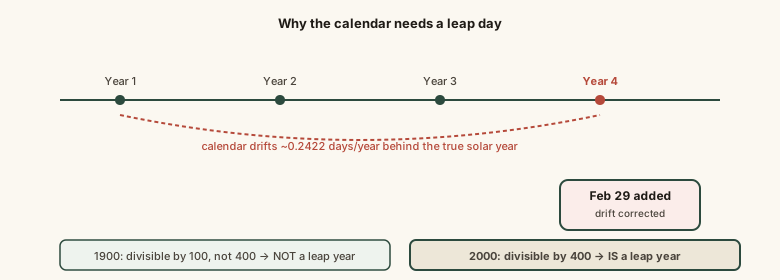
The dashed curve shows the calendar quietly falling behind the true solar year by a fraction of a day annually; the leap day at year 4 snaps it back. The century exception underneath shows the second-layer correction that keeps even that four-year correction from slightly overshooting across many centuries.
Common mistakes
Common Mistakes
✕
Assuming every year divisible by 4 is automatically a leap year, without checking the century exception.
→ For century years (ending in 00), also check divisibility by 400 — only those pass. 2000 is a leap year; 1900, 1800, 2100 are not.
✕
Assuming leap years add a day to make the calendar 'more accurate' in some vague sense, rather than understanding the specific quarter-day drift they correct.
→ Tie it to the concrete number: Earth's orbit is about 365.2422 days, not 365 — leap years exist to correct exactly that ~0.2422-day annual shortfall, nothing more abstract.
✕
Assuming the Gregorian calendar is now perfectly synced forever, with no remaining drift at all.
→ The Gregorian average year (365.2425 days) is still marginally longer than the true solar year (365.2422 days) — a tiny residual drift of about 1 day per 3,300 years remains, just far too small to matter practically.
Common misconception
“Leap years happen every 4 years, no exceptions.”
The every-4-years rule is only the first layer of the Gregorian calendar's leap-year system. Century years (numbers ending in 00) are the exception: they're leap years only if also divisible by 400. This is why 2000 was a leap year but 1900 and 2100 are not, even though all three pass the simple divide-by-4 test — the extra rule exists specifically because 365.25 days per 4 years is itself a slight overcorrection of the true 365.2422-day solar year.
Quick check
Roughly how many days would a calendar with no leap-year correction drift out of sync with the seasons after 100 years?
Try it yourself
Check whether a year is a leap year
Is leap year? (1 = yes, 0 = no)1
What to do next
What to do next
To check any year: first test divisibility by 4. If it fails, it's not a leap year — done.
If a year passes the divide-by-4 test and is also a century year (ends in 00), run the extra divide-by-400 test before concluding it's a leap year.
Use the calculator above to quickly verify any specific year, including tricky century-year cases like 1900, 2000, or 2100.
Remember the concrete reason leap years exist — Earth's real orbit (365.2422 days) is longer than the calendar's default 365 — rather than treating the rule as an arbitrary convention.
FAQ
FAQ
Related terms
Related terms
Leap year
A calendar year with an extra day (February 29) added to keep the calendar synchronized with Earth's actual orbital period around the sun.
Solar year (tropical year)
The actual time Earth takes to complete one orbit relative to the seasons — approximately 365.2422 days, not a whole number.
Gregorian calendar
The calendar system in near-universal civil use today, refined in 1582 specifically to fix leap-year drift left uncorrected by the earlier Julian calendar.
Century exception rule
The Gregorian calendar's additional leap-year rule: century years (1900, 2000, 2100...) are leap years only if divisible by 400, correcting for the leftover drift a simple every-4-years rule would still accumulate.
This entry was researched from public sources and drafted with AI-assisted tools, then edited — errors are still possible. Spot one, or want a topic covered? Read our disclaimer.
 KnowThis