 KnowThis
Key Takeaways
Key Takeaways
- 1mpg measures distance-per-fuel (miles you get from a gallon), so a higher mpg number means better efficiency — while L/100km measures fuel-per-distance (liters burned over 100 km), so a lower number means better efficiency.
- 2Converting between the two isn't a simple multiplication like most unit conversions — because one is a 'the more the better' scale and the other is 'the less the better,' the conversion formula involves dividing a constant by the value, not multiplying by a fixed factor.
- 3The mpg-to-L/100km conversion constant (235.214) is specific to the US gallon — using it on a UK/imperial mpg figure, which is based on a larger gallon, gives a wrong answer.
The concept
Because the relationship between the two units is a reciprocal rather than a fixed multiplier, it's worth working through the actual numbers rather than trying to eyeball a rough equivalence.
A car's fuel efficiency improves. What happens to its mpg number, and what happens to its L/100km number?
Worked examples
Example 1: Converting a typical sedan's mpg to L/100km (baseline case)
Example 2: A highly efficient hybrid, and why the gap narrows at high mpg (edge case / variation)
Which fuel-efficiency improvement saves more actual fuel over 10,000 miles of driving: going from 10 mpg to 20 mpg, or going from 40 mpg to 50 mpg?
Example 3: Comparing a US mpg spec sheet to a European L/100km spec sheet (real-world / applied case)
How it works (visual)
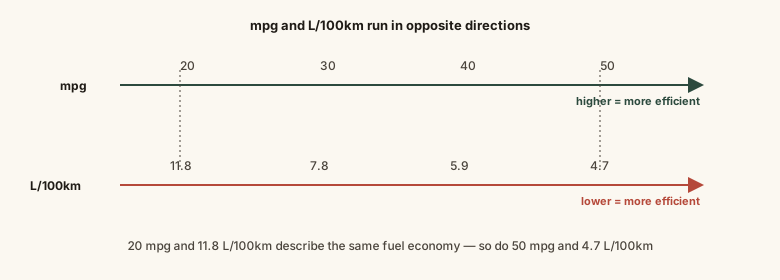
Reading straight down at any point on the mpg scale lands on the equivalent L/100km value — but climbing the mpg scale (more efficient) means descending the L/100km scale, which is the entire reason these two units can't be converted with a simple multiplication factor the way most unit pairs can.
Common mistakes
Common Mistakes
Trying to convert mpg to L/100km with a simple multiplication factor, the way most other unit conversions work.
→ Use the reciprocal formula, L/100km ≈ 235.214 ÷ mpg — this pairing genuinely requires division, not multiplication, because the two scales measure the ratio in opposite directions.
Assuming equal mpg improvements (e.g. +10 mpg) always represent equal real fuel savings.
→ Because of the reciprocal relationship, the same mpg gain saves far more actual fuel at the low end of the scale than at the high end — compare total fuel burned over a fixed distance, not the raw mpg difference.
Using the US-gallon conversion constant (235.214) on a UK/imperial mpg figure.
→ The imperial gallon is about 20% larger than the US gallon — confirm which gallon a given mpg figure is based on before applying a conversion constant.
Common misconception
“A car that improves from 40 mpg to 50 mpg saves about the same fuel as one that improves from 10 mpg to 20 mpg, since both gained '10 mpg.'”
Because mpg and actual fuel consumption are related by a reciprocal, not a straight line, equal mpg gains represent wildly different real savings depending on where they happen on the scale. Over 10,000 miles, 10→20 mpg saves 500 gallons of fuel, while 40→50 mpg saves only 50 gallons — a tenfold difference in real-world impact from an identically sized "+10 mpg" improvement.
Why can't mpg and L/100km be converted using a fixed multiplication factor the way miles and kilometers can?
Try it yourself
What to do next
What to do next
- Use the calculator above with the reciprocal formula (235.214 ÷ mpg) rather than trying to estimate a straight-line conversion.
- When comparing mpg improvements, calculate actual fuel burned over a fixed distance (like 10,000 miles) rather than comparing raw mpg numbers — the real savings aren't linear.
- Confirm whether an mpg figure uses the US gallon or the imperial gallon before converting or comparing it to another source.
- For any cross-region car-shopping comparison, convert both figures into the same unit (either both to mpg or both to L/100km) before judging which is actually more efficient.