 KnowThis
Key Takeaways
Key Takeaways
- 1mph and km/h both measure distance-per-time using ordinary land-based length units (the statute mile and the kilometer) — converting between them is a simple fixed multiplication, 1 mph = 1.60934 km/h.
- 2A knot is not 'nautical mph' in name only — it's built on the nautical mile, a completely different length unit (1,852 meters) defined from Earth's own geometry, not from the statute mile at all.
- 31 knot = 1.15078 mph = 1.852 km/h — both true, but neither is a round number, because knots were never designed to relate cleanly to either land-speed unit.
The concept
Because knots are built on a genuinely different length unit, no shortcut trick (like "just add 15%" for mph, or "just divide by 1.6" for km/h) is exact — the real conversion factors have to be used directly.
Why doesn't 1 knot equal exactly 1 mph, the way you might assume from both being 'speed per hour' units?
Worked examples
Example 1: Converting mph to km/h (baseline case)
Example 2: Converting the same speed into knots (edge case / variation)
A ship's instruments read 20 knots. Roughly how fast is that in mph?
Example 3: Reading an aviation weather report (real-world / applied case)
How it works (visual)
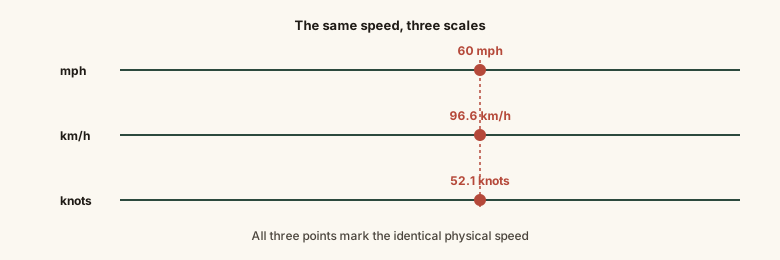
All three markers line up at the same physical speed — the numbers differ only because each scale is built from a different underlying length unit (statute mile, kilometer, or nautical mile), not because the object is somehow moving at three different actual speeds.
Common mistakes
Common Mistakes
Treating knots and mph as roughly interchangeable, or assuming 1 knot ≈ 1 mph.
→ Use the real factor: 1 knot ≈ 1.15078 mph. At higher speeds (aviation, shipping) this ~15% gap is large enough to matter.
Using the mile-to-kilometer factor (1.60934) when converting knots, instead of the knot-specific factor (1.852 for km/h, 1.15078 for mph).
→ Knots are built on the nautical mile, not the statute mile — always use 1 knot = 1.852 km/h or 1 knot = 1.15078 mph, never the land-mile factor.
Assuming the nautical mile is just a rounder or 'nicer' version of the statute mile.
→ The nautical mile (1,852 m) is a genuinely different, longer unit, defined from Earth's latitude geometry — it isn't a rounded or simplified version of the 1,609.34 m statute mile.
Common misconception
“A knot is just the nautical version of mph — same underlying mile, different name for maritime use.”
A knot is built on the nautical mile (1,852 meters, defined from one minute of latitude on Earth's surface), while mph is built on the statute mile (1,609.34 meters, a historical land-measurement unit). These are two different length units, roughly 15% apart — which is exactly why 1 knot converts to about 1.15 mph rather than a clean 1-to-1 match. The name similarity ("mile") hides a real difference in what a "mile" means in each system.
Why do pilots and sailors use knots rather than mph or km/h for navigation?
Try it yourself
What to do next
What to do next
- For mph-to-km/h, multiply by 1.60934 — both units share the same 'land mile' family, so this conversion is simple and exact.
- For anything involving knots, use the nautical-mile-specific factors: 1 knot = 1.852 km/h, and 1 knot ≈ 1.15078 mph — never substitute the statute-mile factor.
- When reading an aviation or maritime weather report in knots, multiply by roughly 1.15 to get an intuitive mph figure if that's more familiar to you.
- Remember the nautical mile's origin (one minute of latitude) if you ever need a quick real-world sanity check on a charted distance at sea.