 KnowThis
Key Takeaways
Key Takeaways
- 1Many unrelated websites, apps, and even physical-world systems like flight dispatch quietly depend on the same small set of shared providers — a DNS service, a cloud region, a telecom network.
- 2When that shared layer fails, everything built on top of it fails simultaneously, even though the individual companies running those apps didn't cause the problem themselves.
- 3This is called a single point of failure, and the real-world fix — spreading critical systems across multiple independent providers — costs more, which is why many organizations accept the risk instead.
The concept
That single incident is a useful case study for how far a shared-dependency failure can actually travel — from one broken file to grounded planes across an entire country.
Several unrelated websites and apps all go down at the exact same time, even though they're run by different companies. What's the most likely explanation?
Worked examples
Example 1: A DNS provider outage (baseline case)
Example 2: A cloud region outage (edge case / variation)
Example 3: The FAA's 2023 NOTAM outage (real-world / applied case)
Why did a single database file failure in one federal system end up grounding flights operated by many different, unrelated airlines?
How it works (visual)
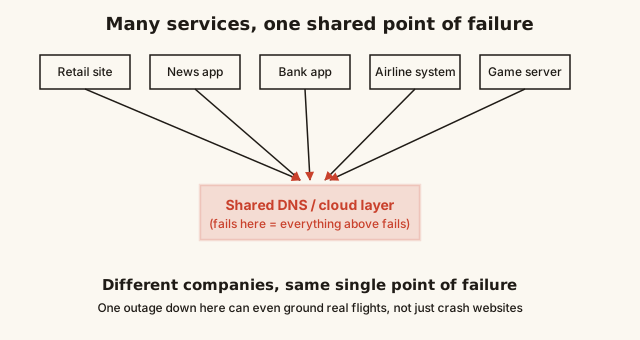
Notice how many separate, unrelated boxes at the top all funnel down into the same single layer at the bottom — that funnel shape is exactly what turns one provider's bad day into what looks, from the outside, like a much bigger and more mysterious outage.
Common mistakes
Common Mistakes
Assuming a broken website means that specific company's own servers or code have a bug.
→ Widespread, simultaneous outages across unrelated sites are much more often a shared-provider failure — check whether other well-known sites are also down before assuming it's a code problem.
Treating "the cloud is down" and "my internet connection is down" as the same problem.
→ A cloud or DNS outage is a failure far upstream, affecting a specific provider's services for everyone; your own internet connection issue is local and typically doesn't affect other people's access to those same services.
Assuming redundancy against this kind of failure is free or automatic once you use a big, reliable provider.
→ Even the largest providers can and do have outages — real protection requires deliberately spreading critical systems across multiple independent providers or regions, which most organizations skip due to cost and complexity.
Common misconception
“A big company's outage is just that one company's website being broken.”
Many outages that look like "one company's website is down" are actually a shared infrastructure layer failing underneath dozens or hundreds of unrelated companies at once — a DNS provider, a cloud region, or a telecom network that all of them happen to rent from. This is why unrelated apps and websites sometimes go down together, and in the FAA's 2023 NOTAM outage, why a single database file failure inside one federal system could ground flights nationwide across every airline, not just the system where the failure occurred.
What to do next
What to do next
- When a website or app seems broken, check a status page or search for the provider's name plus "outage" before assuming it's a problem with your own device or connection.
- If you run or manage a critical system, ask specifically which single providers it depends on for hosting, DNS, and content delivery — and whether a failure in any one of them alone could take the whole thing down.
- Treat vendor redundancy claims skeptically until you know whether critical systems are actually spread across independent regions or providers, not just marketed as "highly available."