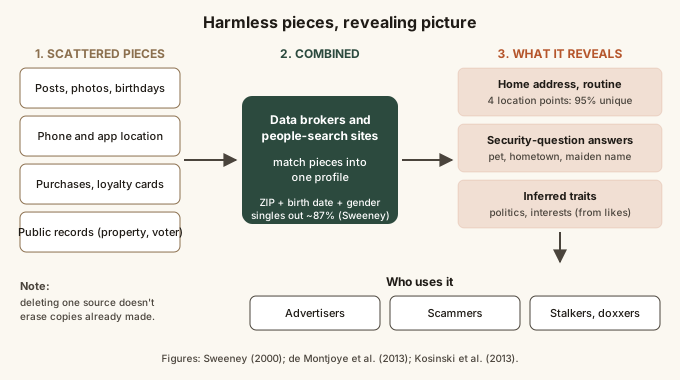
A digital footprint reveals more than any single post because small, harmless-looking details become identifying when combined. Latanya Sweeney's research estimated that 87% of Americans could be uniquely identified from just ZIP code, birth date and gender, and a 2013 study in Scientific Reports found four location points were enough to single out 95% of people in a phone dataset of 1.5 million. Researchers have also predicted traits such as political views from Facebook likes. Data brokers assemble these pieces into profiles, which the FTC found can hold thousands of data points per person. The practical risks are social engineering, account takeover through guessable security questions, stalking and targeted scams. The fixes are to treat old security questions as public, limit location and birthday details, opt out of people-search sites, and lock down account recovery.
Reading time
— 5 min
Updated
— Oct 8, 2026
Fact-reviewed
— Oct 8, 2026
This entry explains how personal data gets combined and used, cited to NIST, the FTC, the UK NCSC and peer-reviewed research. It is general security education, not legal advice. Privacy laws and opt-out rights differ by state and country and change over time (described here as of October 2026). If you are being stalked, harassed or doxxed, contact local law enforcement; for identity theft in the US, use IdentityTheft.gov.
Key Takeaways
Key Takeaways
1Your footprint reveals far more in combination than any single post. ZIP code, birth date and gender alone were enough to single out an estimated 87% of Americans.
2Data brokers do that combining at scale, and scammers use the results to make messages and calls believable or to guess account-recovery answers.
3You can't erase a footprint, but you can shrink what's useful to an attacker: treat security questions as public, limit location and birthday details, opt out of people-search sites and lock down recovery.
The concept
Think of your online life as jigsaw pieces scattered across many tables. A birthday post on one, a gym check-in on another, a photo of your street, a public voter record, a shopping profile. Each piece looks harmless, which is why people share them. The risk comes when someone gathers pieces from several tables and fits them together. Three dull facts, your ZIP code, your birthday and whether you're male or female, are enough to point to just one person for most Americans. Add a few spots where your phone has been and someone can work out where you live and work. Companies called data brokers collect pieces like this full-time and sell the finished pictures. Most buyers are advertisers, but the same pictures help a scammer who wants to call you sounding like your bank, or someone guessing "mother's maiden name" to reset your email password. The question to ask isn't "is this post private?" but "what does this add to the picture?"
Passive data counts too. App permissions for location, contacts and photos feed the same profiles, and the photos you send directly as files, rather than through a platform that strips metadata, can carry the GPS coordinates of where they were taken.
Quick check
Why can three ordinary facts like ZIP code, birth date and gender identify most people?
Worked examples
The people below are hypothetical. The numbers are rough arithmetic to show how combining works, not measurements of any real place.
Example 1: Narrowing the crowd (baseline case)
A ZIP code holds about 30,000 people. Split by gender: about 15,000. Spread those across roughly 80 years of birthdays, about 29,000 possible dates, and the average number of people sharing one exact birth date, ZIP and gender is about 0.5. In other words, most people in that ZIP code are the only person with their combination. That's why a "Happy 34th birthday!" post plus a gym check-in near home is more revealing than it feels.
Example 2: Four dots on a map (edge case)
A weather app shares "anonymized" location data with an advertising partner. There's no name attached, just a device ID. But the device spends most nights at one house and most weekdays at one office building, and visits one particular school at 8 a.m. Those few points match one household. This is the de Montjoye finding in practice: removing the name doesn't make movement data anonymous, because the movement pattern is itself the identifier.
Example 3: The password reset (applied)
Maria's email account still uses security questions set years ago: mother's maiden name, city of birth and first pet. Her mother's public profile lists her maiden name, a people-search site shows Maria's birthplace, and a "throwback" post names the family's first dog. An attacker who knows her email address can answer all three. The fix isn't deleting every post. She replaces each answer with a random string saved in her password manager, turns on app-based two-factor authentication, and checks the recovery phone and email are current. The public details stay public, but they no longer unlock anything.
Quick check
An app shares your location history with no name attached. Is that anonymous?
How it works (visual)
From scattered pieces to a profile: how a footprint gets assembled and used
Common mistakes
Common Mistakes
✕
Judging each post on its own.
→ Ask what a detail adds when combined with what's already public: birthday, hometown, employer, routine.
✕
Answering security questions truthfully.
→ Treat them as public. Use random answers stored in a password manager, and prefer accounts that offer app-based two-factor authentication.
✕
Posting location in real time.
→ Share trips and check-ins after you've left. Real-time posts reveal when your home is empty and where to find you.
✕
Assuming deleting an account deletes the data.
→ Also opt out of people-search sites and request deletion from data brokers where your state's law allows it.
Common misconception
“I have nothing to hide, so my digital footprint doesn't matter.”
The main risks aren't about secrets. They're about ordinary facts being combined: your address and routine for a stalker, your family names for a scammer impersonating a relative, your old answers for someone resetting your email. NIST guidance stopped treating such personal facts as secure for exactly this reason.
What to do next
What to do next
Search your own name with your city in a search engine and on a few people-search sites, and note what comes up.
Use each site's opt-out process; if you live in a state with a data-broker deletion law, use its official request system.
Replace security-question answers on your email and bank accounts with random strings saved in a password manager.
Turn off location access for apps that don't need it, and turn off precise location where approximate is enough.
Review who can see your birthday, hometown and family members on social profiles, following the NCSC's social media guidance.
If your details have been used in fraud, report it at IdentityTheft.gov (US) or your national fraud reporting service.
FAQ
FAQ
Related terms
Related terms
Digital footprint
The trail of data you leave online, both what you post on purpose (active) and what devices, apps and sites record about you (passive).
Quasi-identifier
A detail that doesn't name you on its own, such as ZIP code or birth date, but can single you out when combined with other details.
Re-identification
Matching supposedly anonymous data back to a specific person by linking it with other information.
Data broker
A company that collects personal information from public records, purchases, apps and other sources, and sells or licenses profiles built from it.
Social engineering
Manipulating people into giving up access or information, often using personal details to make a scam message or call believable.
Knowledge-based authentication
Verifying identity with personal facts such as a first pet's name or mother's maiden name, which are often findable online.
Doxxing
Collecting and publishing someone's private details, such as a home address, usually to harass or intimidate them.
This entry was researched from public sources and drafted with AI-assisted tools, then edited — errors are still possible. Spot one, or want a topic covered? Read our disclaimer.
 KnowThis